
Book Review:
Aindra: Kirtan Revolution
by Kalachandji das
Reviewed by Lori Erbs, MLS
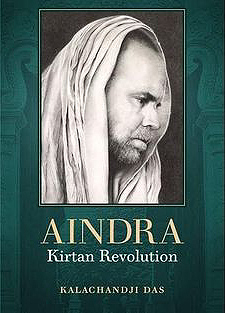 419 pages, ISBN: 978-0-9995419-I-3
Inword Publishers, 2022
This compelling biography portrays
the swift transformation of Eddie Striker into a contemporary bhakti yogi and
kirtan artist christened Aindra dasa. Seeking spiritual inspiration amidst the
American cultural revolution of the seventies, Eddie met the Hare Krishna
devotees and quickly assimilated into their effusive lifestyle of street
chanting, colorful festivals, distribution of literature and sacred vegetarian
food. He received formal initiation in January 1974 from His Divine Grace A.C.
Bhaktivedanta Swami Srila Prabhupada into the International Society for Krishna
Consciousness (ISKCON), in direct lineage from the Gaudiya Vaishnava
Sampradaya. Early in his pursuit of philosophical enlightenment he was seeking
the highest expression of perfection and truth, at times boldly challenging the
fledgling ISKCON to adhere to the original teachings of its founder, Srila
Prabhupada.
By the turn of the decade, Aindra
navigated his way to Vrindavan, India, a sacred village described by his guru
as a place where:
“The trees of that land are all
desire trees: you can have anything you want from any tree. The land is made of
touchstone and the water is nectar. In that land all speech is song, all
walking is dancing, and the constant companion is the flute.”
He joined the ISKCON sanctuary in
Vrindavan and began serving the deities as a pujari, or priest, spending free
time in the temple room chanting and playing mridanga, a traditional drum used
in Vaishnava circles. He was surprised that the 24-hour kirtan, which Srila
Prabhupada had ordained as a vital element of this shrine, had ceased. After a
few months he decided to return to America and launch an innovative traveling
festival so as to share such divine culture with others. By Spring 1983 he’d
established regular daily kirtan performances at Rockefeller Plaza, Times
Square and Bryant Park (behind the New York City Public Library), and convinced
an ISKCON leader to loan money for a down payment on a truck. After months of
painstaking and overtime labor this masterpiece was unveiled before his
superiors:
“On the outside, the vehicle appeared
to be just a basic white truck, but the two side doors opened to an ornate
temple room, with golden pillars supporting North-Indian-style arches
constructed with polyurethane, backdropped by red curtains reaching down to a
black-and-white checkered floor. The ceiling was draped with beautiful Indian
cloth and held a pair of crystal chandeliers….Early every morning, before rush
hour traffic began, the white truck would pull up to a sidewalk and Aindra, in
saffron robes, would emerge from the driver’s door and fill the parking meter
with coins. The two side doors would swing open, clouds of incense would billow
out while exotic Indian shenai ragas
resounded from a Peavy sound-system…”
<>Each day Aindra and his five-man
musical ensemble would chant the Hare Krishna mantra from the mobile temple for
eight to twelve hours, stopping to chat with and sharing food that had been
blessed with onlookers. Finally, in Spring
1986, after enduring excessive organizational politics and what he perceived as
a watering-down of the Krishna conscious discipline, Aindra decided to return
to Vrindavan.
He resumed his eight-hour daily
kirtan at the ISKCON temple in Vrindavan (also known as Vraja), with only a few
devotees joining him at first. On October 12, 1986, after hearing of a dream by
an elderly local temple authority in which Srila Prabhupada was crying and
asking why there was not 24-hour kirtan any more, Aindra re-initiated 24-hour
kirtan at the Vrindavan ISKCON temple. Bhurijana (a senior devotee and teacher)
explained:
“Aindra’s kirtan became a trademark
for the temple—and Krishna-Balarama was one of the only temples in Vraja where
kirtan went on continuously. And then…the temple became famous throughout
India….everyone would dance and chant, and it had such an extreme effect.”
Organizing and maintaining constant
kirtan at this temple involved not only recruiting and training Krishna monks
or Vrindavan residents in the art of chanting the holy names of God, but also
fundraising, providing shelter and spiritual guidance for his team. He made a
vow to never leave Vrindavan, even during the extremely hot summer season,
voluntarily accepting the harsh life of a renounced ascetic in a habitat that
afforded few material comforts. Aindra advised his followers:
“…one can cultivate the mood of
Vraja-bhakti, which basically means pure unalloyed exclusive selfless
devotional service which is exclusively dedicated to the pleasure of Radha and
Krishna…that’s what Prabhupada is trying to teach, train us up from the very
beginning.”
Aindra not only offered exceptional pujari
service to the deities of Radha-Shyamasundara at the temple, but taught others
the intricacies of such exalted devotional dealings. His lifelong quest for
deeper internal realizations led him to meet with and inquire about his eternal
relationship with Krishna from Bhaktivedanta Narayana Maharaja:
“…Maharaja replied that he could
reveal the desired information but that Aindra would first have to accept his
shelter. ‘I refused him,’ Aindra later told a few of his closest associates….‘I
said that I already had a spiritual master.’”
Aindra stressed to friends and students
that one did not have to go outside ISKCON for revelation or higher esoteric
knowledge of bhakti, that Srila Prabhupada had already provided a solid
foundation for attaining perfection and was still available to his disciples
and followers, through ISKCON society, Prabhupada’s books, teachings and
transcendental presence.
Eventually, financial pressure to
maintain the 24-hour kirtan motivated Aindra to record and sell cassette tapes
of his kirtans, including the famous Vrindavan
Mellows album, which became an overnight sensation around the globe.
“In 1999 Aindra released Vraja
Vilasa, a double CD, which…conveyed the vibrancy…of his live festival
kirtans….The recordings were at the forefront of a developing worldwide kirtan
culture—a progressive, even revolutionary, movement that was bringing back an
enthusiasm…for the kind of nama-sankirtana
[chanting of the Hare Krishna mantra] that had marked the early days of
ISKCON.”
Although constantly absorbed in
chanting the holy names of God and attending to external and internal care of
the deity forms of God, Aindra still pushed himself and others to engage in
intense menial labor such as cleaning and renovating the restrooms and
courtyards of the temple ashram. Seekers would flock to hear him perform at the
Vrindavan temple kirtan and some begged for initiation, but he did not feel
himself qualified to become a guru.
In 2002 Aindra had a series of
dreams in which Srila Prabhupada asked him to write a manuscript about book
distribution. As with other projects he immersed himself completely in this
endeavor, entitling it The Heart of
Transcendental Book Distribution. Far surpassing the basic tactics of
marketing books and bhakti outreach, this work capsulized Aindra’s realizations
about reawakening one’s spiritual identity, the actual mission of ISKCON and
flaws therein.
At the 2009 observance of Srila
Prabhupada’s disappearance anniversary, Aindra, the last devotee to speak
before the Vrindavan temple assembly, revealed the full extent of his radical
nature:
“To hell with toeing the party line!
To hell with the institutionalism of
the institutionalists!
…To hell with being a Hare Krishna
yes-man!
…I say to hell with the Hindu cash
cow!”
Aindra continued his unabashed
critique of ISKCON, exceeding his time limit for speaking and shocking his
audience. After leaving the temple to return to his quarters the Master of
Ceremonies knocked on his door to inform him that the authorities did not wish
for him to lead kirtan that evening—the first time in over twenty years that
Aindra would not be chanting in Srila Prabhupada’s room on his disappearance
day. The leaders demanded an immediate apology, which he delivered the next morning
before the devotees. However, they were not satisfied with his explanation; they
thought he should have admitted he was wrong for what he said and the way he
expressed his emotions, but Aindra refused to retract his statements, asserting
that he “only spoke the truth.” From then on, Aindra faced constant threats of
expulsion from the temple and censorship of his controversial book, which had
not yet been released. Although withdrawing into a cloistered ring of trusted
friends, he still continued the 24-hour kirtan, but began to contemplate his
death:
“‘I don’t really want to stay in this
world anymore,’ he told Mukunda Datta.
‘I want to die in Vrindavan,’ he told
Giridhari and Ati Sundari. ‘In the hottest heat of the summer, when there is no
one around, at the feet of my Nitai saci-suta, and all alone with no one to
bother me…’”
On the evening of July 15, 2010
devotees heard an explosion outside near the Vrindavan temple gurukula and
others noticed smoke coming out of the pipe from Aindra’s back window. They
knocked on his door, but he didn’t answer and his DO NOT DISTURB sign was in
place. When he didn’t arrive the next morning at the temple to dress the
deities they broke open the door to his room, thickly permeated with gas and
blackened from a scorching fire. Aindra’s dead burnt body was prostrated before
his Nitai saci-suta deities, somehow fulfilling his desire to leave this world
as previously articulated.
Although
including his personal dealings with Aindra, Kalachandji das presents this
narrative in a flowing, transparent manner that reveals the heart of a unique
kirtan revolutionary, who surrendered blood, sweat and tears to cultivate the
chanting program in Vrindavan and around the planet via his recordings. A saint
of such caliber is a rare find in this age: an ordinary American whose devout
spark was ignited into a flame and subsequent firestorm that detonated bhakti
fervor and blazed trails of principles and integrity for generations into the
future.